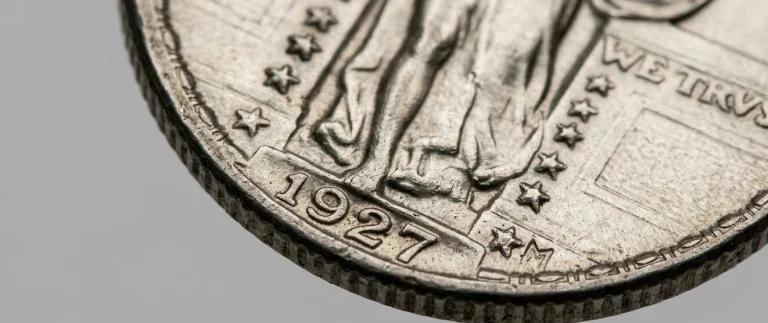
Evaluating 1927 quarters requires understanding specific Standing Liberty series nuances.
The 1927 quarter value stems directly from objective data found in auction sales records.
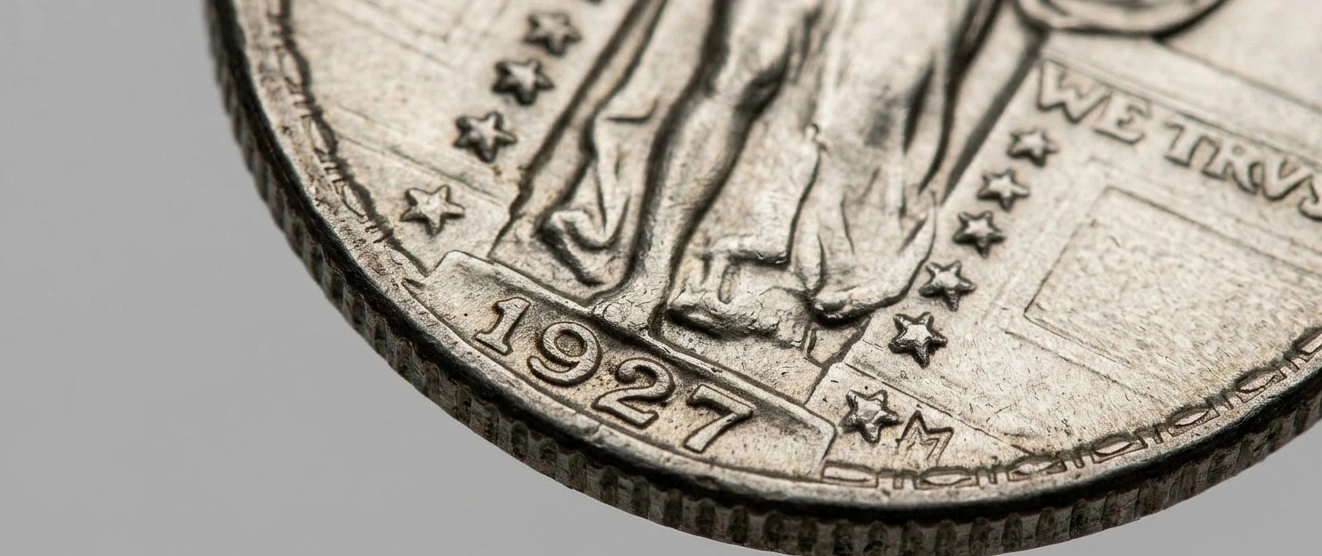
| Parameter | Value |
| Mass | 6.25 grams |
| Diameter | 24.30 millimeters |
| Metal Content | 90% Silver, 10% Copper |
| Edge Type | Reeded |
| Designer | Hermon MacNeil |
Origin Factor: Mintage Distribution
Minting location determines the rarity of a specific specimen.
Philadelphia produced the highest volume of coins during this year.
Denver and San Francisco showed significantly lower output numbers.
- Philadelphia (no mint mark): 11,912,000 units
- Denver (D mark): 976,000 units
- San Francisco (S mark): 396,000 units
San Francisco’s 1927 production ranks among the lowest in the entire series.
Grading and Detail
Sheldon’s system classifies coins from 1 to 70 points.
Wear on the shield or Liberty’s knees reduces the grade category.
Having a full visible date remains critical for commercial resale.
Weak date strike → Loss of 60% market value.
Condition Classifications:
- Good G4: Heavy wear, figure outlines appearing flattened
- Very Fine VF20: Drapery folds visible, shield details distinguishable
- About Uncirculated AU50: Retaining partial original mint luster
- Mint State MS63: No trace of wear, minor marks present
- Full Head FH: Complete detail on the helmet atop Liberty’s head
1927 Philadelphia (No Mint Mark) Price Points
Coins from Philadelphia remain the most accessible for building a collection.
Price dynamics over the last three years show moderate growth.
| Condition | 2024 Price | 2025 Price | 2026 Price |
| G4 | $12 | $14 | $15 |
| VF20 | $28 | $30 | $32 |
| EF40 | $55 | $60 | $65 |
| MS63 | $180 | $195 | $210 |
| MS65 FH | $750 | $820 | $900 |
Growth Statistics: 2024–2025: +8% 2025–2026: +7%
Rarity of the 1927-D Issue
Denver production features a medium level of availability.
Finding coins graded above MS65 presents a significant challenge.
Rarity cause → Low survival rate of coins in circulation.
1927-D Price Levels:
- VG8: $35
- VF20: $110
- EF40: $240
- AU50: $480
- MS63: $1,150
- MS65 FH: $4,200
Record price for 1927-D MS66 FH: $14,400
The Scarce 1927-S Issue
San Francisco released a critically small quantity of coins.
This year serves as a key date for the Standing Liberty series.
Specimen values rise exponentially when moving to higher grades.
1927-S Price Dynamics:
- Low Grades G4–VG8: $50 → $90
- Mid Grades VF20–EF40: $180 → $450
- High Grades MS60–MS63: $2,800 → $5,500
- Exceptional Grades MS65 FH: exceeding $120,000
Supply volume on the 2026 market: extremely limited.
Full Head FH
The FH designation applies to coins with flawless head detail.
Helmet lines must appear clearly separated.
Lacking this detail drops the price 2.5 to 4 times.
FH percentage in the general population:
- Philadelphia: 12%
- Denver: 8%
- San Francisco: 3%
FH rarity → Increasing premium by 250%
Value Changes in Percentages
| Coin Group | Annual Growth | Cumulative Growth |
| Common (P) | 5% | 16% |
| Rare (D) | 12% | 40% |
| Key (S) | 18% | 64% |
High grades paired with rare mint marks yield maximum profit.
Professional Certification Impact
Selling coins without independent laboratory reviews has become difficult.
Certification confirms authenticity and grade accuracy.
Possessing an NGC or PCGS holder guarantees asset liquidity.
Certification service costs: from $25 to $150.
Certificate influence on final sale price:
- Low-value coins: +15%
- High-value coins: +45%
- Unique grades: +100%
Counterfeit and Modification Detection
Rising prices encourage the appearance of fake mint marks.
Modifying the S letter on a 1927 coin happens frequently.
Verification requires using a coin checker app.
Authenticity Signs:
- Mint mark shape matching 1927 standards
- No solder marks surrounding the letter
- Weight matching the 6.25 gram standard
- Natural tarnish over the entire surface
Weight below 6.10 grams → Evidence of cleaning or forgery.
Price Structure: Cause → Effect
Logical connections in Standing Liberty Quarter pricing.
- Low mintage 1927-S → High base price
- Weak head strike → No FH status → Price drop
- Mechanical cleaning → Loss of original surface → 70% discount
- Rainbow tarnish → Increased aesthetic appeal → 20% premium
- Doubled Die errors → Targeted by specialists → 150% price increase
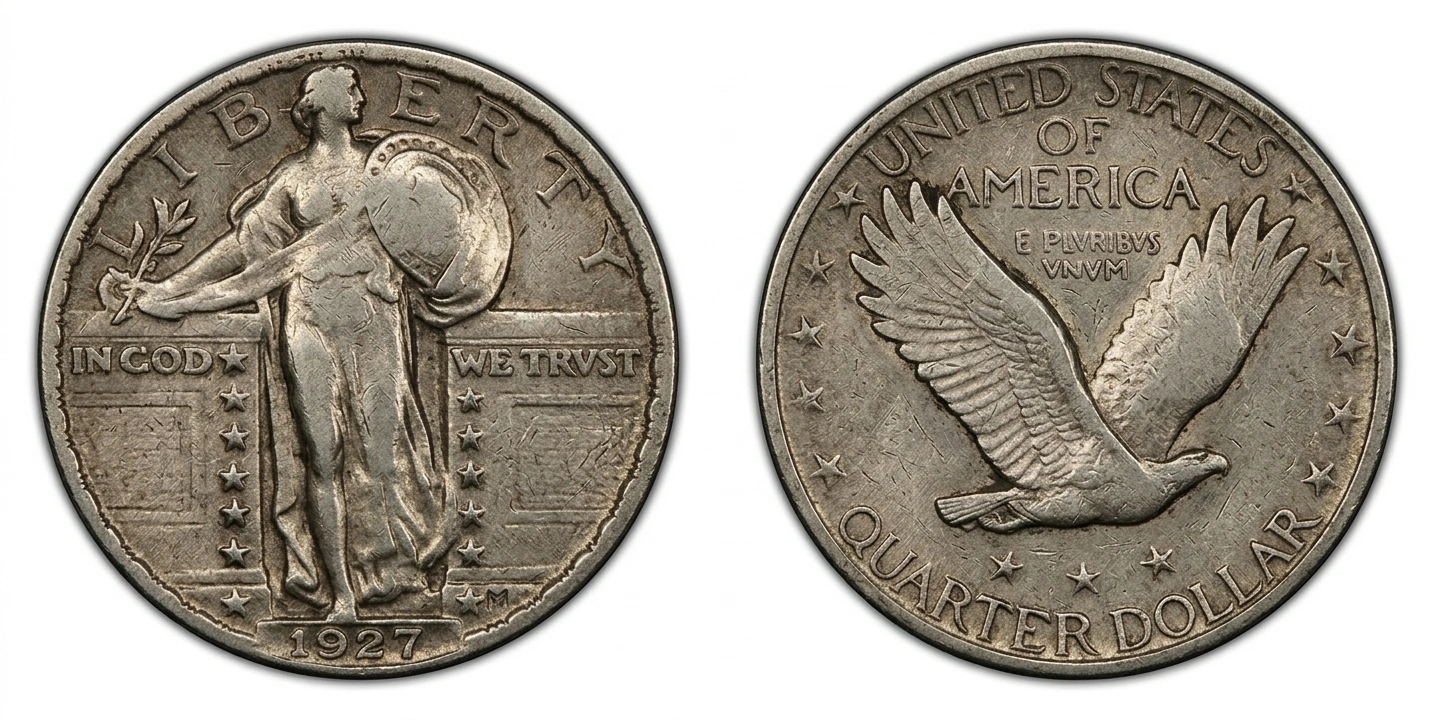
Comparative Rarity
Integral rarity index based on surviving specimen data.
| Issue | Rarity (1-10) | Availability in MS |
| 1927 | 2 | High |
| 1927-D | 6 | Medium |
| 1927-S | 10 | Extremely Low |
Purchasing Evaluation Criteria
Investors must check coins against a specific list.
Following rules minimizes capital loss risks.
- No brush cleaning marks
- Clearly defined date digits
- Uniform field luster
- Intact rim edges
Discovering planchet defects → Additional uniqueness factor.
Auction Record Analysis
Sales statistics recorded significant sums for exceptional samples.
Data updated as of February 2026.
- 1927-S MS67 FH: $185,000 (Heritage Auctions)
- 1927-D MS66 FH: $16,200 (Stack’s Bowers)
- 1927 MS68 FH: $5,800 (Private sale)
Average holding period before resale is 7 years.
Short-term speculation in this segment proves less effective.
Surface Wear and Tarnish
Coin metal undergoes natural oxidation over time.
Dark tarnish formation is not considered a defect.
Removing tarnish destroys numismatic value, which you can determine via the app to scan coins for value.
Price difference between cleaned and original coins:
- Original MS63: $210
- Cleaned MS63: $65
Applying chemical solutions → Irreversible metal structure damage.
Storage and Conservation
Grade preservation depends on environmental conditions.
Humidity and temperature shifts speed up surface damage.
Using plastic capsules with inert materials is recommended.
Storage Requirements:
- Air humidity: below 35%
- Temperature: 18–22 degrees Celsius
- No direct sunlight exposure
- Safe usage with a dehumidifier